
Document numbers and the Kode Bayar
Who this is for: an owner or bookkeeper wondering where the neat invoice numbers went.
Transactions get a random code
Section titled “Transactions get a random code”Invoices, orders, payments, delivery notes and journal entries are named with a short random code such as acccqo8kqb. Every business on Bakulai shares one system, and a running number like SINV-2026-00012 would let anyone guess another business’s document. A random code cannot be guessed.
It is unique, permanent and safe to quote internally — but it is not what you ask a customer to type.
What you give the customer: Kode Bayar
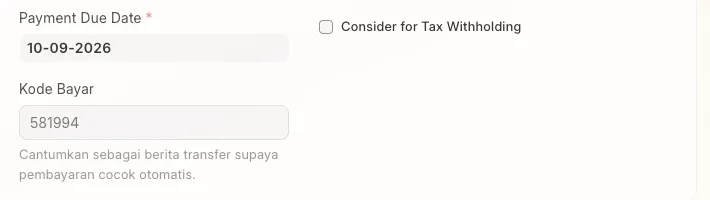
Section titled “What you give the customer: Kode Bayar”Every sales invoice carries a Kode Bayar — six digits, shown under the due date and printed on the invoice.
- Ask customers to put it in the transfer note: “Berita transfer: 482913”.
- Automatic bank reconciliation looks for exactly this code in your bank mutation text and matches the payment to the invoice by itself.
- It is generated once, never changes, and is unique within your company.
Master data numbering
Section titled “Master data numbering”| Record | How it is named | Example |
|---|---|---|
| Customer | running series, the real name stays in the name field | CUST-2026-00047 — Klinik Mitra Sehat |
| Supplier | running series | SUP-2026-00008 |
| Item | your own item code plus your company initials | GAUZE-001-BT1 |
| Shared lists (item group, unit, warehouse, customer group) | name plus your company initials | General - BT1, Pcs |
The initials come from the abbreviation on your Company Profile. They exist so two businesses can both have an item called GAUZE-001 without colliding — you type the plain code, Bakulai adds the suffix.
Related
Section titled “Related”Draft, Submit, Cancel · Bank reconciliation · Invoice look and letterhead